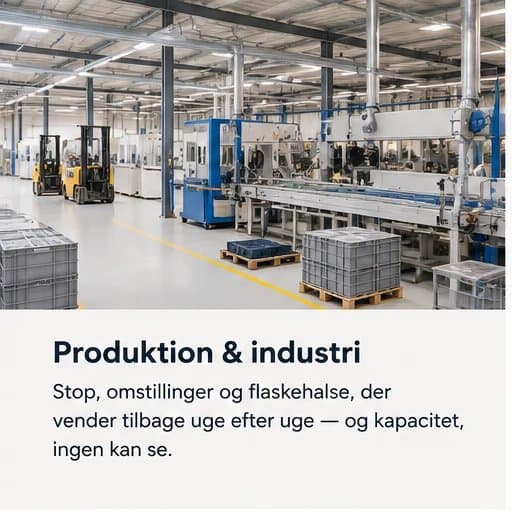
The week starts with a plan that rarely survives until lunch.
Two unplanned stoppages, a changeover that takes three hours instead of one, and a quality deviation that has already moved downstream. The team works hard, and OEE still lands at 63.
The 37 per cent nobody can account for.
An OEE of 63 means more than a third of planned production time goes to stoppages, reduced speed or rework. The loss is real, but it appears nowhere as a single number, and so nothing is done about it.
This is not a staffing problem. It is a question of what gets measured, what gets seen, and who has the mandate to act on it the same day.
OEE below 75 with no clear explanation
The number is known, but not what drives it.
Changeover times swing from day to day
The same task, very different durations.
Stoppages are handled reactively
The machine runs again, but the cause remains.
Operations rest on tacit knowledge
The experienced people know what was never written down.
What we build in a manufacturing operation
Three things recur. They are not solved by putting more pressure on the team, but by making operations visible and giving them a steady rhythm.
The capacity is hidden
- OEE is not measured, or not used actively
- No systematic root-cause analysis of stoppages and losses
VSM and OEE mapping make the loss visible and the basis for decisions concrete.
The same faults keep coming back
- Fixes hold briefly, then the fault returns
- The cause is not analysed, only the symptom is treated
CAPA routines that hit the cause and document that the fix held.
Everything escalates to the production manager
- No fixed daily review on the floor
- The team has no mandate to solve things itself
A daily management structure where most problems are closed on the floor.
How mature is your production?
Eight questions, about two minutes, and a concrete picture of what is holding operations back.
Free · 8 questions · approx. 2 minutes
Where is your operation strong, and where does it falter?
The operations check scores your answers against the four phases we work in — map, build, execute, embed — and names the first real step. Nothing leaves your browser unless you ask for the report by email.
Take the operations checkFour phases that move a plant from management by firefighting to an organisation that finds and solves its own problems.
Map
VSM and OEE measurement show exactly where capacity disappears: stoppages, changeovers, speed loss, quality faults.
Build
Daily tier meetings, visible operating boards and escalation rules that give the team a mandate to solve problems themselves.
Execute
We embed the standards for changeover, preventive maintenance and quality control, side by side with the team.
Anchor
Shift leaders and middle managers are trained in the daily routines that keep operations running, whether or not we are there.
Next steps
Start with a measurement, or read how we go about it.
Tools
Frequently asked questions
What is OEE, and why does it matter for my plant?
OEE (Overall Equipment Effectiveness) measures how much of planned production time is actually spent producing quality output. It breaks down into availability, performance and quality. An OEE of 65 means 35 per cent of capacity disappears into stoppages, reduced speed or rework, without anyone necessarily knowing exactly why.
What are typical OEE levels in Danish manufacturing?
Based on contributions to the Danish OEE Index, many Danish manufacturers sit between 55 and 75. World class is typically defined as 85 and above. Most companies therefore have substantial unused capacity without investing in new equipment.
What is daily management in a production context?
A structured daily routine, typically a tier meeting of 10 to 15 minutes, where the team reviews yesterday’s results, identifies deviations and agrees actions. It ensures problems are handled the day they arise rather than piling up for the weekly meeting.
What does an engagement cost?
It depends on scope and objectives. We always start with an initial conversation, no obligation, where we map the situation and say honestly whether and how we can help, before a plan or a price is put together.
When this makes sense
We work best with manufacturing and industrial companies where the capacity is there, but stoppages and fluctuations eat it up. Here is when we are the right match, and when we are not.
This is built for you, if…
- Stoppages, changeovers and bottlenecks return week after week.
- There is capacity no one can really see — OEE is measured by gut feeling rather than numbers.
- Operations depend on a few key people, and improvements don’t last.
- You may have run an improvement project before that didn’t stick in the day-to-day.
We are probably not the right fit, if…
- You are looking for a quick report, not a lasting change in the day-to-day itself.
- You want a consultant to take over your operations, rather than building you up to run them yourselves.
- You are in an acute crisis that calls for a turnaround here and now.
By saying it up front, we save you the time, and ourselves an engagement that wouldn’t have lasted anyway.
Let us look at what actually costs you capacity.
We map your situation and say honestly whether and how we can help, before a plan is drawn up.