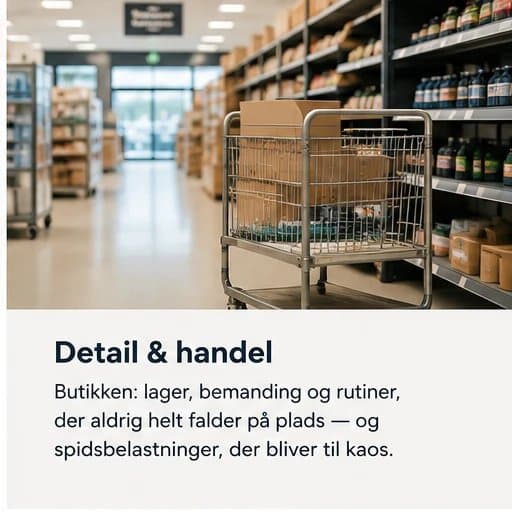
Being busy is not the same as running steadily.
In the store and the stockroom the problem is rarely a shortage of work. It is a shortage of systems that hold operations up when things get busy.
Saturday morning. A queue at the till. The shelf is empty.
One of your fastest-selling lines is out of stock. The reorder should have triggered itself, but nobody owned checking the min and max levels, because the person who usually does it was on holiday.
This is not bad will. It is a system resting too heavily on habit and individual memory. When those go, the overview goes with them.
Peak loads turn into chaos
No backup routines and unclear ownership when volume rises.
Stock levels rarely match
Counting and reordering run on habit, not on system.
Onboarding takes a long time
The routines exist only in experienced colleagues’ heads.
Opening and closing are done differently
No fixed standard, and the errors arise in the shift changes.
What we build in a store
The simple structures that make operations visible and steady, whoever is on shift that day.
Everything ends with the store manager
- No fixed daily review of status and errors
- Opening and closing are done differently by everyone
Daily operating routines that resolve problems before they grow, without consuming management time.
The process is full of waste
- Duplicated work at goods receipt and stocktaking
- Time spent looking for goods and information
Shorter lead time and a lower error rate with what you already have.
Roles and ownership are unclear
- Tasks fall between two stools in busy periods
- No clear owner for stock, staffing and till routines
A clear division of roles, so everyone knows what belongs to whom.
Four phases that move a busy store from running on experience and personal memory to running on systems and habits.
Map
We uncover when and why operations break down: stock discrepancies, staffing gaps, routines that get skipped, and what each incident costs.
Build
Visual systems for stock and staffing, daily checklists and simple communication routines.
Execute
We embed the routines on the repeated situations: opening, closing, goods receipt, till reconciliation and peak load.
Anchor
The systems are anchored in management’s daily behaviour, so they live on when staff change.
Next steps
Start with a measurement, or read how we go about it.
Tools
Knowledge
Frequently asked questions
Wouldn’t it just be better to hire another store manager?
Extra management does not help if the systems are not there. We often see businesses that have hired their way out of the problems, only for them to return, because the routines are neither documented nor anchored. The structure has to carry operations, not individuals.
Our sector is seasonal. Can it be structured at all?
Yes. Seasonal variation is precisely a reason why stable routines and handover structures matter: you cannot train from scratch in the middle of peak season. Standardised processes for opening, closing and staffing give the foundation that holds in high season.
What is the timeframe for an engagement?
A typical anchoring engagement for a retail business runs 8 to 12 weeks. The first results, for example a shared overview of stock and staffing, are visible within the first two weeks.
We already have an IT system for stock control. Is this relevant?
Yes. We work with your existing systems, not against them. Many challenges are not about missing software, but about the processes and ownership around the system not being defined clearly enough.
When this makes sense
We work best with retail and trading businesses where the revenue is there, but the day-to-day never quite settles into a steady rhythm. Here is when we are the right match, and when we are not.
This is built for you, if…
- Stock, staffing and routines never quite fall into place — no matter who is on shift.
- Peak loads turn into chaos because a steady operating rhythm is missing.
- The same problems return week after week and eat into your margins.
- You have tried introducing new routines before, but they didn’t hold when the day-to-day pressed in.
We are probably not the right fit, if…
- You are looking for a quick report, not a lasting change in the day-to-day itself.
- You want a consultant to take over your operations, rather than building you up to run them yourselves.
- You are in an acute crisis that calls for a turnaround here and now.
By saying it up front, we save you the time, and ourselves an engagement that wouldn’t have lasted anyway.
Make chaos the exception.
We go through your operations and give an honest assessment of the scope for improvement.