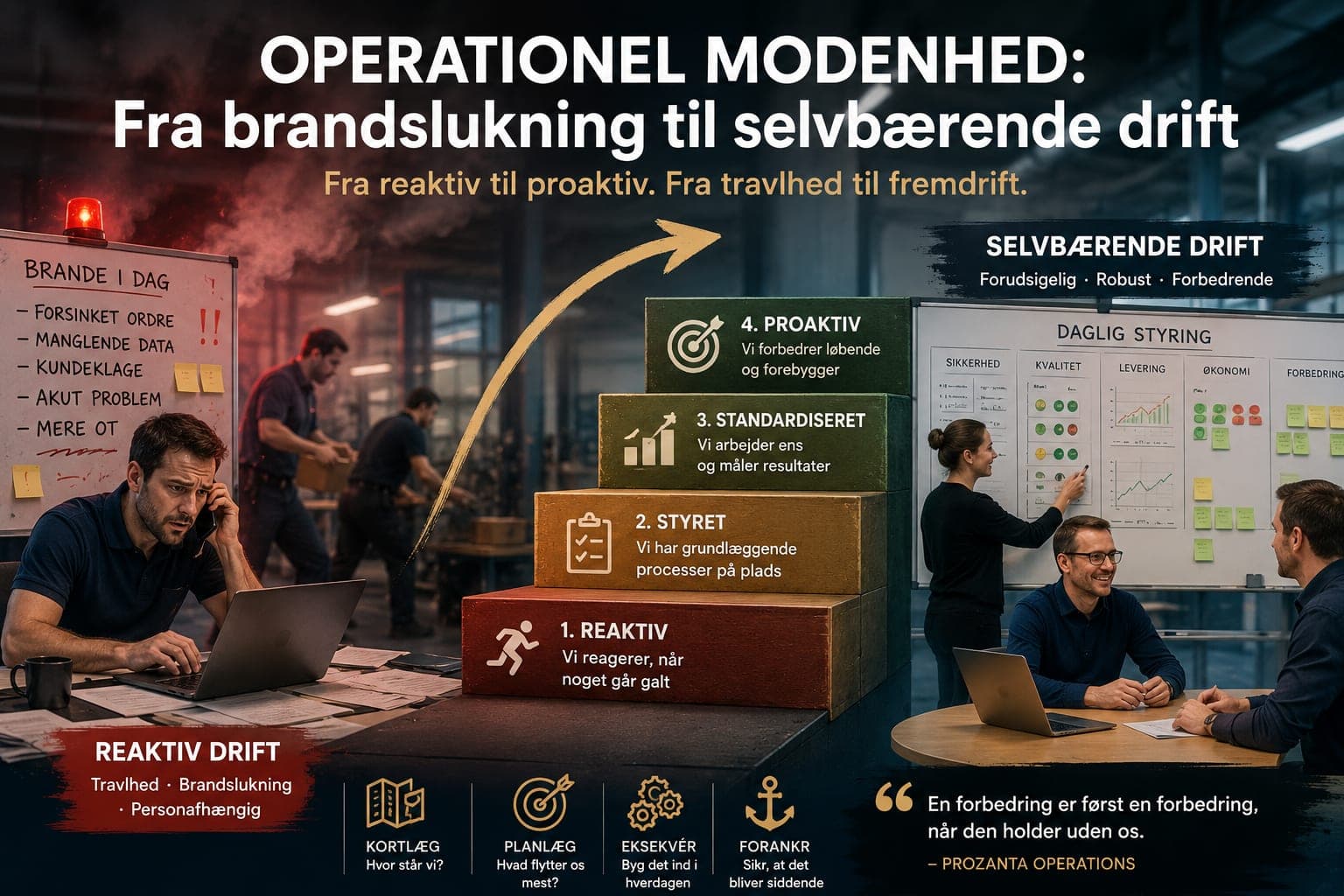
Ask an owner-manager how operations are running and the answer usually falls into one of two kinds. One goes: "We're busy, and we solve things as they come up." The other: "It runs — even when I'm not there." The difference between the two isn't luck, and it's rarely the skill of the employees. It's maturity.
Operational maturity is an attempt to put words to something most people sense but fewer can measure: how self-sustaining operations really are. Do problems get solved once and for all, or do they keep coming back? Do things run because systems have been built for it, or because particular people remember how it's done? That is the difference between a company that is forever putting out fires and one that has learned to avoid them.
Most companies are stuck on the same rung
A maturity model typically describes a ladder from reactive to proactive operations. On the lower rungs, everyday life is governed by whatever is burning right now. Things work, but they work because someone is running hard. When a key person is off sick, it is felt immediately. Higher up the ladder, operations are predictable: routines are standardised, problems are caught early, and improvements stay put because they are built into the way people work, not into individuals' memories.
What's interesting is how many companies are stuck on the lower rungs without knowing it. They mistake busyness for progress. And they do so because the reactive rung has a built-in reward that is hard to spot.
The trap: we reward firefighting
Think about who gets recognition in a pressured working day. It is usually the person who rescues a late order at the last minute — the visible effort everyone can see. The person who quietly built a routine so the order was never at risk rarely gets a word of thanks. After all, there was no problem.
MIT researchers Nelson Repenning and John Sterman described the mechanism in their work on process improvement and called it the capability trap: when pressure rises, the organisation falls back on working harder rather than working smarter. Prevention takes time you don't feel you have, so it gets deprioritised, and that creates more fires, which demand more firefighting. Over time the organisation learns that heroics pay off and that preventive work is invisible. You promote the firefighters and wonder why it never gets any calmer.
This is not a sign of poor employees. It is a system that rewards the wrong behaviour. And it is precisely why many improvement projects lose their effect after three to six months: the symptoms have been treated without touching what keeps the company stuck on the rung.
Why higher maturity is about behaviour, not tools
This is where it gets concrete for management. Moving up a rung is rarely about introducing yet another tool. Most companies have tried board meetings, 5S or KPIs before. The tools weren't the problem. What decides whether they last is the behaviour around them, and management's in particular.
Industrial anthropologist John Shook, who helped turn around Toyota and GM's joint NUMMI plant in the 1980s, made a point that is still underrated: you don't change a culture by changing how people think. You change what people do, make it easy to do the right thing, and hold firm — then attitude and culture follow. NUMMI was turned from one of GM's worst plants into one of its best with essentially the same workforce. It was the system and the management behaviour that were replaced, not the people.
It echoes something the quality pioneer W. Edwards Deming said long ago: the vast majority of problems in an organisation stem from the system, which is management's responsibility, not from the individual employees. Maturity is, at bottom, a measure of how well the system and the behaviour are built to carry operations when no one is watching.
How to move up a rung
Raising maturity is a craft that follows a sequence. Skip a step and you usually fall back. In practice, four moves recur:
First you map where you actually stand. Not a gut feeling, but an honest assessment against the model, rung by rung. Where are operations reactive, and where are they already stable? That gives a baseline, and a clear picture of the distance up to where you want to be.
Then you build a plan that closes the gap step by step. Which few changes move the most, and in what order? A roadmap that respects the fact that each rung is the precondition for the next.
Next you execute the changes into everyday work. This is where most efforts are decided — because it requires management to change its own routines, not just the employees'. To be present at the board meeting. To ask questions instead of dictating answers. To treat a deviation as something to learn from.
Finally you anchor it, so it holds. Standard work, clear ownership and a way to catch relapses before they grow. An engagement has only succeeded when operations are still running on the new rung a couple of months after the help has withdrawn. Anything else is a temporary campaign.
The last point is the most important, and it is also the one we at Prozanta hold ourselves to. An improvement that only lasts while someone is standing over it is not a real improvement. That is why we work in phases — map, build, execute, anchor, and stay in operations until they run without us. The fixed potential audit we offer as an entry point is, in practice, exactly that first step: an honest mapping of where you stand and how much there is to gain.
"An improvement that only lasts while someone is standing over it is not a real improvement."
— Prozanta Operations
The simple question
You don't need a model to sense where you stand. Start with one question: if two of your key people were away for a month, would operations carry on roughly unchanged, or would they grind to a halt? The answer says more about your operational maturity than any report. And it points, at the same time, to where the work should begin.
Sources
- Repenning, N. P. & Sterman, J. D. (2001). Nobody Ever Gets Credit for Fixing Problems That Never Happened. California Management Review, 43(4), 64–88.
- Shook, J. (2010). How to Change a Culture: Lessons from NUMMI. MIT Sloan Management Review, 51(2).
- Deming, W. E. (1986). Out of the Crisis. MIT Press. — see The W. Edwards Deming Institute.
The references show the professional basis. Sources are reproduced in their original language.