The case sits still, and nobody knows why.
Five days in the system, and four of them were spent waiting: on an answer, on an approval, on somebody passing it along. The work itself took an hour.
Everyone is busy. The backlog grows anyway.
The team works hard. Even so, the pile of unfinished cases is never smaller than the week before. New enquiries land in the inbox while three cases wait for approval from a manager who does not know they are waiting.
This is not a capacity problem but a flow problem. The work gets done, but it stops, circulates and restarts, because ownership and handovers are not clear.
Processing times swing
No visibility into what creates the delays.
The backlog grows despite the workload
The work gets done, but not in the right order or at the right pace.
Processes depend on individuals
When the key person is away, the cases stand still.
Nobody sees the workload
Bottlenecks are spotted too late, or never.
What we build in an administration
We map where the flow breaks down and build the simple systems that give cases pace from start to finish.
Work that stops and waits
- Cases circulate back and forth without moving on
- Approval queues delay simple decisions
A clear case flow with explicit changes of ownership and escalation rules that keep cases moving.
Visibility is missing
- The manager spots bottlenecks from complaints, not from data
- No shared overview of what the team is working on
A visual work flow showing volume, status and obstacles, updated and visible to everyone.
Standards that go unused
- Procedures are written, but nobody follows them
- Onboarding new staff is slow and inconsistent
Short, usable work instructions anchored in daily routines, not in document folders.
Four phases that give administrative improvements roots. Not as a project, but as new leadership behaviour and daily routines.
Map
We draw the information flow from enquiry to completion and find where work stops, circulates or waits.
Build
Visual boards, shorter meetings and clear prioritisation rules that give teams a common direction without heavy IT.
Execute
We embed the standards on the most frequent and most error-prone case flows.
Anchor
Managers are trained in the daily routines that keep the systems alive, whatever the staff turnover.
Next steps
Start with a measurement, or read how we go about it.
Tools
Knowledge
- Operational maturityWhat separates an organisation that is ready to improve from one that is not.
- Daily Management in practiceWhat actually happens when you introduce structured daily operating routines.
- Cost of Quality in administrationWhat errors, rework and deviations cost in your case flow, calculated in hard currency.
Frequently asked questions
Can Lean be used in administration? It isn’t manufacturing.
Yes, and it is one of the places with the largest untapped potential. Administrative processes are full of waiting, duplicated work and unclear handovers. Lean is about flow and about removing waste, and that applies whether the item is a physical part or a case being processed.
We have already tried standardising. It doesn’t hold.
That is a classic symptom: standards are written as documents but never implemented in daily management practice. We do not start by writing procedures. We start by building the daily routines that make it natural to use them.
What is a realistic timeframe?
A typical anchoring engagement runs 8 to 12 weeks. The first visible changes, for example a shared overview of case status and shorter coordination meetings, usually appear within the first two to three weeks.
Does it involve a lot of IT and new systems?
No. We work with the systems you already have and start from the processes actually carried out. The solutions are simple by design: a board, a checklist, a ten-minute meeting.
When this makes sense
We work best with administration and service organisations where the tasks pile up and the responsibility isn’t always clear. Here is when we are the right match, and when we are not.
This is built for you, if…
- Case piles and deadlines stack up, and the overview disappears in a busy day-to-day.
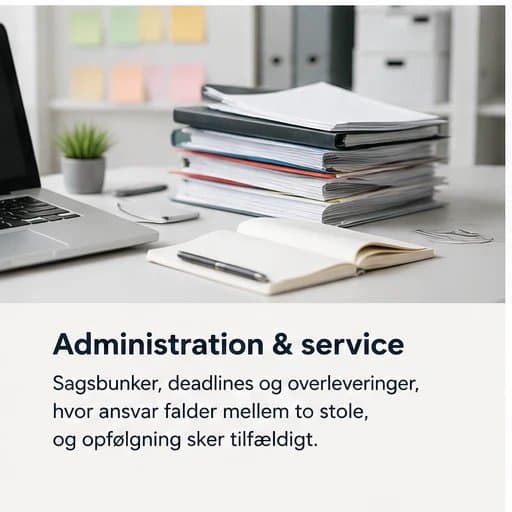
- Responsibility falls between two stools, and follow-up happens by chance rather than on schedule.
- Handovers slip, and the same work is redone several times.
- Customer enquiries about the same problem keep returning, because the cause sits further up the flow.
- You have tried cleaning up the processes before, but it didn’t stick.
We are probably not the right fit, if…
- You are looking for a quick report, not a lasting change in the day-to-day itself.
- You want a consultant to take over your operations, rather than building you up to run them yourselves.
- You are in an acute crisis that calls for a turnaround here and now.
By saying it up front, we save you the time, and ourselves an engagement that wouldn’t have lasted anyway.
Free up capacity in your administration.
We go through your processes and give an honest assessment of the scope for improvement.