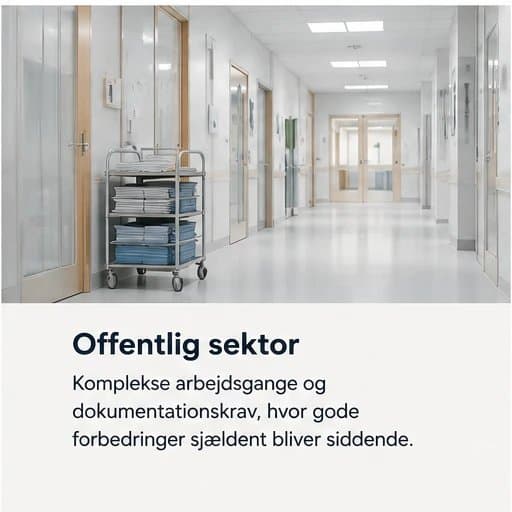
Good improvements that do not stay in place.
In municipalities, agencies and institutions the will to improve is rarely the problem. What is missing is the anchoring.
The project succeeded. The improvement did not hold.
You ran an improvement project. Workshops, mapping, a new way of working. It worked for two months. Then came a change of staff, a new political focus and an urgent case, and suddenly you were back in the old patterns.
This is not a failure of leadership. It is the absence of the daily structures that carry a new practice forward. A project ends. Management routines do not.
Improvements do not hold
The change lives in the project, not in the routines.
Workflows depend on individuals
Cases are handled differently depending on who has them.
Documentation creates extra work
Requirements are treated as a nuisance rather than as an overview.
Nobody sees case progress
Managers spot problems too late, or from citizens’ complaints.
What we build in a public-sector unit
Simple, concrete routines anchored in daily management behaviour rather than in a project document.
Improvements do not hold
- The project ends and the habits slide back
- New management or staff turnover resets the progress
Anchoring in daily management behaviour, so improvements live on because the systems carry them.
Responsibility falls between two stools
- Cases circulate across departments without a clear owner
- Decisions drag on with no clear decision-maker
A clear responsibility matrix and escalation structure, so everyone knows who owns what.
Nobody sees case progress
- Problems are spotted from citizens’ complaints
- No fixed daily review of status
Visual management and daily routines that surface and resolve deviations in time.
Four phases that give improvements roots. Not as a project, but as a new way of leading and organising the daily work.
Map
We map case flows and workflows from enquiry to completion and uncover where time and capacity disappear into waiting, rework and unclear ownership.
Build
Tier meetings, visual case overviews and daily coordination routines that create visibility without heavy IT solutions.
Execute
We embed the workflows on the most frequent and most error-prone processes, short enough to use and clear enough to follow.
Anchor
The systems are anchored in managers’ daily behaviour, so they survive staff turnover, reorganisation and the next project.
Next steps
Start with a measurement, or read how we go about it.
Tools
Knowledge
- Leadership behaviour is the foundationWhat decides whether an improvement survives the first quarter.
- Operational maturityWhat separates an organisation that is ready to improve from one that is not.
- Why Lean implementations failThe five most common causes, and what separates the engagements that succeed.
Frequently asked questions
Can Lean be used in the public sector without colliding with legislation and contracts?
Yes. Lean is about removing non-value-adding activity from workflows, not about circumventing rules or reducing documentation requirements that have a legal basis. We always adapt the approach to the regulatory context.
We have tried improvement projects before. They never hold. What do you do differently?
Most improvement projects fail in the anchoring phase. We do not start with a project, but by building the daily management routines that carry the improvements forward: visual management, daily follow-up and anchoring with the middle managers.
What is the timeframe for a typical public-sector engagement?
A typical engagement runs 10 to 16 weeks depending on complexity. The first visible changes, for example a shared overview of case status and shorter meetings, usually appear within the first three to four weeks.
Does it involve a lot of meetings and workshops?
No. We work close to daily operations, not in the meeting room. Typically it involves shorter, focused observation and design sessions with the people who actually do the work, not only the managers.
When this makes sense
We work best with public-sector units where the will to improve is there, but the day-to-day and the complexity take over. Here is when we are the right match, and when we are not.
This is built for you, if…
- Complex workflows and heavy documentation requirements eat time away from the core task.
- Good improvements are launched but disappear again when everyday life takes over.
- Operations hang on a few experienced employees, and knowledge is rarely shared systematically.
- You have been through projects before that looked good on paper but didn’t change the day-to-day.
We are probably not the right fit, if…
- You are looking for a quick report, not a lasting change in the day-to-day itself.
- You want a consultant to take over your operations, rather than building you up to run them yourselves.
- You are in an acute crisis that calls for a turnaround here and now.
By saying it up front, we save you the time, and ourselves an engagement that wouldn’t have lasted anyway.
Improvements that hold.
We go through your workflows and give an honest assessment of what it takes to anchor them.