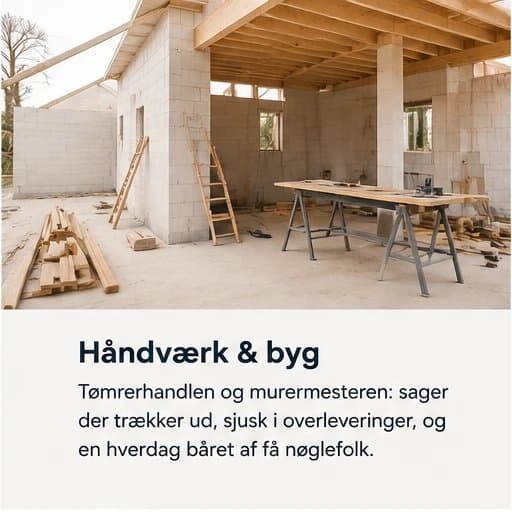
The craft sits in the hands. The operation sits in the systems.
In the carpentry firm, the plumbing business and the masonry trade, the craftsmanship almost always delivers. It is the handovers, the planning and the dependence on key people that cost.
The job that never quite closes.
A job starts well. By the fourth week it is clear something is loose: the plumbing crew did not know the shell was not ready. The carpenter is waiting on a decision that never came in writing. The client calls with questions nobody can answer with certainty.
This is not slackness. Everyone knew what to do. Nobody knew what had to be ready before they arrived. What is missing is a handover system, not craftsmanship.
Jobs drag on and run over budget
No clear milestone structure and unclear ownership at handover.
Handovers sit loose
What must be ready, who checks it, and when, is not defined.
Operations depend on one person
The boss knows everything. If he is ill, the job stands still.
The same faults keep coming back
The problem is fixed, but the cause is never analysed.
What we build in a trades business
Simple structures that keep the job on track from day one to the client’s signature. Not a new app, and not a training course.
Quality depends on individuals
- Tasks are done differently depending on who is on
- Faults arise in handovers between trades
Operations run steadily, whoever is at work that day.
Everything ends on the boss’s desk
- No fixed daily review of status and obstacles
- Decisions wait on one key person
Daily routines that resolve problems the day they arise.
The same faults keep coming back
- Fixes hold a couple of weeks, then the fault returns
- The cause is not analysed systematically
CAPA routines that hit the cause, not the symptom.
Four phases that move a capable trades business from depending on individual memory to running on systems.
Map
We draw the job flow from first client visit to handover and find where time and money disappear: waiting, rework, uncertain handovers.
Build
Tier meetings, task overviews and simple handover checklists that keep everyone in place.
Execute
We embed the standards on the tasks that go wrong again and again: starting a new job, internal handover, client handover.
Anchor
The owner and middle managers are trained in the daily routines, so operations hold the next time a key person is on holiday or changes job.
Next steps
Start with a measurement, or read how we go about it.
Tools
Knowledge
- Leadership behaviour is the foundationWhy it is the boss, not the system, that decides whether improvements last.
- Why Lean implementations failThe five most common causes, and what separates the ones that succeed.
- Skill matrix and flexibilityVisualise competences and reduce vulnerability to key people.
Frequently asked questions
Can Lean even be used in a trades business?
Yes, and often with faster visible effect than in manufacturing. Trades businesses have many repeated processes — starting a job, handover, completion — that lend themselves to standardisation. It is not about more paperwork, but about the right things happening right the first time.
What does it cost to get started?
We always start with a no-obligation conversation where we go through your job flow and give an honest assessment. We then fit the engagement to your size and situation. A shorter anchoring engagement can deliver concrete results within 8 to 12 weeks.
We are only eight people. Isn’t that too small?
No. Smaller businesses typically see results faster, because changes can be made directly without a long decision chain. Dependence on key people and missing handover routines are particularly critical in small teams, and those are exactly what we address.
What if the owner isn’t behind it?
Then nothing holds. That is why we always start by securing ownership at management level. We work with the owner and the middle managers, not around them. In our experience the biggest barrier is putting the problem into words, not solving it.
When this makes sense
We work best with trades and construction businesses where operations have grown but the structure hasn’t kept up — from the smaller crew to the established contractor. Here is when we are the right match, and when we are not.
This is built for you, if…
- Operations hang on the boss and a few key people — if they fall ill, things grind to a halt.
- Jobs drag on, and handovers between people and crews slip too often.
- The same sloppiness and the same mistakes cost you time and rework again and again.
- You may have tried tightening up before, but it slid back as soon as things got busy.
We are probably not the right fit, if…
- You are looking for a quick report, not a lasting change in the day-to-day itself.
- You want a consultant to take over your operations, rather than building you up to run them yourselves.
- You are in an acute crisis that calls for a turnaround here and now.
By saying it up front, we save you the time, and ourselves an engagement that wouldn’t have lasted anyway.
An operation that does not hang on one person.
We go through your job flow and give an honest assessment of what is holding you back and what it takes.